| !! |
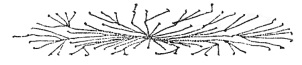
in all the “concern” has about 500 million marks of its own money and 1,333 million marks of borrowed money |
|
the author has squares with the name of the bank |
Source: Lenin’s Collected Works, 4th English Edition, Progress Publishers, Moscow, 1968, Volume 39, p. 175
Translated: Clemens Dutt. Edited by M. S. Levin
Public Domain: Lenin Internet Archive (2026). You may freely copy, distribute, display and perform this work; as well as make derivative and commercial works. Please credit “Marxists Internet Archive” as your source.
Die Bank, 1912, 2.
“Herr von Gwinner’s Oil Monopoly” (1032—) (Dr. Felix Pinner).
[cf. p. 13 here[1] sic!] The Reichstag, on March 15, 1911, adopted almost unanimously a request for an oil monopoly. The government seized upon this “popular” (1032) idea. It turned out that the banks… “could not agree on the booty” (1033). Only the Deutsche Bank was in favour!! The others (headed by the Discontogesellschaft) were against, partly because they considered the Deutsche Bank’s booty excessive.[2]
The struggle between the banks is useful for business: “Only when the interested parties exposed one another—and they did so thoroughly, in a masterly way and with intimate knowledge of their mutual weaknesses—did clarity become possible” (1034)…
The consumers are afraid of terrific (“colossal”, 1034) prices. The Standard Oil Co. served the consumer excellently.
The oil trust could be fought only by an electricity monopoly, by converting water-power into cheap electricity. But we shall get an electricity monopoly only when this becomes profitable to the producers.
“But the electricity monopoly will come when the producers need it, that is to say, when the next great crash in the electrical industry is imminent, and when the gigantic, expensive power stations now being put up at great cost everywhere by private electrical ‘concerns’, which are already obtaining certain franchises from towns, from states, etc., can no longer work at a profit. Water-power will then have to be used. But it will be impossible to convert it into cheap electricity at state expense; it will also have to be handed over to a ‘private monopoly controlled by the state’, because private industry has already concluded a number of contracts and has stipulated for heavy compensation for its expensive steam-power plants, which will impose too great a burden on the ground-rent of a state-controlled hydropower monopoly. So it was with the nitrate monopoly, so it is with the oil monopoly, so it will be with the electric power monopoly. It is time our state socialists, who allow themselves to be blinded by a beautiful principle, understood, at last, that in Germany the monopolies have never pursued the aim, nor have they had the result, of benefiting the consumer, or even of handing over to the state part of the promoter’s profits; they have served only to facilitate, at the expense of the state, the recovery of private industries which were on the verge of bankruptcy”[3] (1036, author’s italics). [N.B.] [sic!] [!!] [“tribute” to finance] [capital !!] [N.B. N.B.]
[there is a table of “interconnections” in oil “concerns”] The Deutsche Bank was defeated by the Standard Oil Co. and in 1907 concluded with the latter (under compulsion) a very disadvantageous agreement by which, in 1912, the Standard Oil Co. was able to buy up cheaply the oilfields of the Deutsche Bank.
And so the Deutsche Bank set to work to build up a monopoly!!
Opposing the Deutsche Bank was the Discontogesellschaft (with its Deutsche Erdöl Aktiengesellschaft), which worked very cautiously for an agreement with the Standard Oil Co.
Die Bank, 1912, 2, p. 695:
| “Statistics of English Joint-Stock Banks” (England and Wales). |
Colonial banks |
| Deposits (£ million) |
||||||||||
|---|---|---|---|---|---|---|---|---|---|---|
| N.B. | 1890— | 104 | banks | (joint-stock) | with | 2,203 | branches | 368 | ||
| 1911— | 44 | ” | ” ” | ” | 5,417 | ” | 749 | |||
| In Scotland | ||||||||||
| 1890— | 10 | ” | ” ” | ” | 975 | ” | ||||
| 1911— | 9 | ” | ” ” | ” | 1,227 | ” | ||||
| In Ireland | ||||||||||
| 1890— | 9 | banks | (joint-stock) | with | 456 | branches | ||||
| 1911— | 9 | ” | ” ” | ” | 739 | ” | ||||
| Colonial banks | ||||||||||
| N.B. | 1890— | 30 | ” | ” ” | ” | 1,742 | ” | |||
| 1911— | 38 | ” | ” ” | ” | 3,645 | ” | ||||
Die Bank, 1912, 2 (629 et seq.). “Oil Strategy” by Felix Pinner:
on the one hand, the Germans (Discontogesellschaft and Erdöl Aktiengesellschaft) want to unite Rumania (and Russia) against the Standard Oil Co.;
[N.B. division of the world by the oil trusts] on the other hand, Standard Oil founded a company (Nederlandsche Koloniale Petroleum Maatschappy) in Holland herself, buying up oilfields (and concessions) in the Dutch Indies—a blow against its chief rival: the Anglo-Dutch trust Shell (Koninklijke Shell), etc.
Struggle for division of the world. “Division of the World”, p. 630.
Anglo-Dutch trust—Asia.
Standard Oil—rest of the world.
Standard Oil wants to seize everything.
The Germans want to defend themselves (+ Rumania + Holland + Russia??).
Die Bank, 1912, 1.
[Cinema trust!!] “The Patriotism of the Trusts”, by L. Eschwege: in Germany a trust has been formed for buying up film distributors! (The firm of Pathé (Paris) produces 80,000 metres of film daily at one mark per metre. The cinemas of the world put together yield an income of about one thousand million marks per year!!) (pp. 216-17). This industry lags behind in Germany; it is especially developed in France. In Germany about forty distributing agencies buy up films and “lease” them to cinema owners. (A trust has been formed, Deutsche Filmindustrie A.-G. = Fiag, headed by the National-Liberal Deputy Paasche. Its capital = five million marks, of which “no small part”, obviously, was intended to be used as “founders’ profit”)… A monopoly is being launched. Will it succeed??
Die Bank, 1912, 1 (p. 223 et seq.), a short article by A. Lansburgh: “The Financial Transactions of the Princes’ Trust” (the name given by the Stock Exchange to the “business affairs” of Prince Fürstenberg and Prince Hohenlohe, wealthy financiers). They invested millions (of their own and of the Deutsche Bank) in the building firm of Boswau & Knauer. It raked in as much as 100,000,000 marks (!! p. 229), embarked on a host of very risky enterprises and went bankrupt. The Deutsche Bank lost about twelve million marks, Fürstenberg about eight million (p. 226), the whole extent of the crash being covered and concealed (p. 226). Extremely indignant, the author writes: “Our whole economic development is infected by some of the Knauer poison” (230)… “The principle by which they (Boswau & Knauer) have worked, is hardly different from that, for example, to which the two biggest German electrical concerns owe their successes” (228)…[4] [true face of the Deutsche Bank!!!] [and sic!! “electrical concerns”]
If Boswau & Knauer had managed to wriggle out by making others bear the risk, everyone would have praised them, and hundreds and hundreds would have been ruined!
Die Bank, 1912, 1.
L. Eschwege, Etatisation of Capitalism (p. 12—). The Reichstag elections. The battle of conservatives and democrats. “The question of whether the people or the bureaucracy should rule is still being debated, but the decision has already been made in favour of a third force, namely, the plutocracy” (12) … “political freedom becomes an empty phrase in a country where the economic sources of wealth have become the monopoly of a few supermen” (12). Capitalism is being etatised: members of Zemstvos!! (municipality, district, etc.) are being appointed to Supervisory Boards. For example, in the Tempelhofer Feld Aktiengesellschaft. What a shady business!! “Petty hypocrisy” (15)—these delegates also receive bonuses, etc., etc. “A situation which is intrinsically dishonourable” results (16)… Government officials make “common cause with the plutocracy” (19)…
“Foreign Capital Investments in Canada”, p. 82 et seq.
| British | >2,000 | million dollars | ||
|---|---|---|---|---|
| American | 420 | |||
| French | 80 | 80 | ||
| German | 32 | 32 | ||
| Belgian | 11.5 | |||
| Dutch | 11 | |||
| 123 |
L. Eschwege, The History of a Company Promotion. (p. 420 et seq.)—an aerodrome company.
Flugplatz Johannisthal near Berlin. The director Arthur Müller enlisted princes and princelings, took millions from them (share capital = 4 1⁄2 million marks), “gratis shares” for himself, resold them (the expert opinion of a venal valuer was that this land would yield colossal profit… in 10-20 years!!)—in general a gross deception, and everything strictly legal!!
[American banking magnates] A. Lansburgh, “The Money Trust” (p. 432 et seq.).
The National City Bank (Rockefeller and the Standard Oil Co.) controls a capital of about $1,000 million. The Bankers Trust Co. (Morgan) controls a capital of about $1,500-1,750 million. [2 banks—2,750 million dollars (=11,000 million marks)[5]]
The author points out that nowhere are banks so strictly regulated as in America (“deposit” banks are strictly separated from “investment” banks; branch banks are forbidden, also the loan to any one person of more than 10 per cent of the capital, and so on). America has 26,000 “Lilliputian” banks (438)—and all to no purpose!! In reality the multi-millionaires rule and control. A change in the laws will merely lead to a change in the form of their rule.
Die Bank, 1912, 1, p. 523 et seq.
L. Eschwege, “Cultural Fertiliser” = German immigrants in Brazil. Unscrupulous advertising of the Brazilian Government (like that of the Canadian). Agents are paid ten marks for each immigrant. Lies about the prosperity of the immigrants, their poverty, etc., etc. They are sold land at speculative prices, etc., etc.
Die Bank, 1911, 1, p. 1 et seq.
[N.B. title!] A. Lansburgh, “Germany—A Rentier State”.
Deposits in German savings banks = about 16,500 million marks. This is a transfer of capital from a latent to a patent state, an aid to big capital, a conversion into loan capital (mostly in mortgages). By refraining from disposing of their money themselves, the depositors “strengthen the power of big capital and weaken the strength of resistance of small-scale industry” (8).
“People in Germany are ready to sneer at the inclination to become rentiers that is observed in France. But they forget that as far as the bourgeoisie is concerned the situation in Germany is becoming more and more like that in France”[6] (10-11).
About 45 of the amounts (45 per cent, apparently) in savings banks consist of deposits of 3,000 marks or over!!
Ibidem, p. 218: German Banks
| Banks | Own capital | Borrowed capital | ||
|---|---|---|---|---|
| 1883 | 160 | 890 | + | 850 (mill. marks) |
| 1907 | 440 | 4,450 | + | 7,750 ” ” |
| +175% | +400% | + | 812% ” ” |
Austrian Banks
| (million kronen) | |||
|---|---|---|---|
| Banks | Own capital | Borrowed capital | |
| 1883 | 38 | 500 | 620 |
| 1907 | 53 | 1,130 | 3,130 |
| +40% | +126% | +405% | |
Die Bank, 1911, 2, p. 605 et seq. “Twenty Years of English Banking”, by Alfred Lansburgh.
|
Development of English banks |
Banks | Deposits and current accounts |
Scotland | Ireland | Capital (England+ Scotland+ Ireland) |
Reserves | ||||||
| 1891[7] | 110 | 408.5 | +91.6 | +38.5£ mill. |
69.8 | 36.4 | ||||||
| 1911 | 46 | 776.6 | 106.6 | 62.5 | 78.7 | 49.0 | ||||||
| Branches of | 46 English banks— | 5,218 (1910) | ||||||||||
| Isle of Man | 2 | 9 | ||||||||||
| Scottish | 9 | 1,242 | ||||||||||
| Irish | 9 | 693 | ||||||||||
p. 813 et seq. Germany
| No. of banks | Own capital (thousand mill. marks) | Borrowed money | Total capital at the disposal of the banks | ||||||
|---|---|---|---|---|---|---|---|---|---|
| 1872 | 174 | 1 | 1 | 3,000 mill. marks | Development of banking in Germany |
||||
| 1910 | 422 | 5 | 11 | 30,000 ” ” |
1872… 23 banks out of 174 had a capital of 10 million and >. They controlled 60 per cent of borrowed money.
1910-11… 53 banks out of 422 had a capital of 10 million and >. They controlled 82.5 per cent of borrowed money (p. 818).
Germany, output of iron 1870: 1,346,000; 1910: 14,793,000 tons.[8]
L. Eschwege, “Plutocracy and Officialdom” (p. 825 et seq.). Typical of a petty-bourgeois reformist. Two examples:
“Some years ago, owing to the rigid attitude of the Rhine-Westphalian Coal Syndicate, a strong anti-cartel movement swept through Germany. The Reich government appointed an Enquiry Committee to study the problem of cartels. In the course of its proceedings, Government Counsellor Völker distinguished himself by his brilliant mastery of the subject and his sharp business-like speeches against the cartel representatives. Shortly thereafter, Counsellor Völker accepted a highly paid post as leader of the German Steel Association, Germany’s most powerful and closely-knit cartel organisation. With the government thus deprived of its best expert, the enquiry petered out” (827-28). There is no need, he remarks, to point to America! [good example! (finance capital and the government)[9] ]
There is an Imperial Private Insurance Supervisory Office, which has done much to control private insurance companies. And then the insurance companies come along and entice the “controllers” with offers of lucrative posts (including directorships). “In recent years, no less than three control officials have made the leap from the Imperial Supervisory Office to a directorship in an insurance company” (831). [!!]
Die Bank, 1911, 1, pp. 94-95. Recent statistics on the iron industry.
| (Thousand tons) | ||||||||||
| production of pig-iron |
1810 | 15 | 158 | 54 | — | — | — | |||
| 1820 | — | — | 20 | 198 | — | 1,650 | ||||
| 1850 | — | 2,228 | 564 | 405 | 204 | 4,187 | ||||
| 1870 | 1,346 | 6,059 | 1,665 | 1,178 | 360 | 12,021 | ||||
| 1890 | 4,625 | 8,033 | 9,203 | 1,962 | 727 | 27,427 | ||||
| 1910 | 14,793 | 9,664 | 27,250 | 3,500 | 2,870 | 60,000 | ||||
Die Bank, 1910, 1 (p. 401 et seq.), Alfred Lansburgh, “The Bank in the Service of the National Economy”—in connection with Riesser’s book, whom the author accuses of optimism and of ignoring the defects of the German banks.
[“holdings” of the modern bank!!] Idem: Alfred Lansburgh, “The Holdings System in German Banking” (497 et seq.) and “Dangers of the Holdings System”. Both articles yield very little; generalities, already known. The table of “holdings” (p. 500) alone is good.
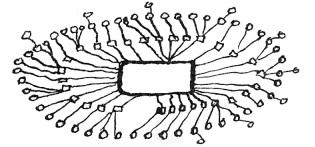
| The Deutsche Bank[10] has holdings | ||||||||||||||||||
| (1) | Permanently | in | 17 | banks. | Of | these | 9 | have | holdings | in | 34 | banks; | Of | which | 4 | also | in | 7 |
| (2) | For an indefinite period | ” | 5 | ” | ———————— | ————————— | ———— | |||||||||||
| (3) | Occasionally | ” | 8 | ” | ” | ” | 5 | ” | ” | ” | 14 | ” | ” | ” | 2 | ” | ” | 2 |
| ((My totals)) | 30 | 14 | 48 | ” | ” | ” | 6 | ” | ” | 9 | ||||||||
[N.B.] [of these, i.e., out of 8—two Russian: the Siberian Commercial Bank and the Russian Bank for Foreign Trade, and one Austrian: the Wiener Bankverein]
both banks and bankers included
System of “holdings” N.B.
approximately thus
| !! |
in all the “concern” has about 500 million marks of its own money and 1,333 million marks of borrowed money |
|
the author has squares with the name of the bank |
apparently, these data on the Deutsche Bank can be taken to illustrate the holdings system
|
approximately thus: the size of the bank in the centre (the Deutsche Bank) is not in proportion, for among the subsidiaries are banks with a capital of 70-80 million marks! |
|
||
Die Bank, 1910, 1, p. 288. A note: “German Concessions Abroad.”
The Chamber of Commerce in Barmen writes in a Memorandum to the Minister of Trade:
“A considerable amount of German capital is invested in the Transvaal gold mines, despite which, unfortunately, supplies from German engineering factories for the Transvaal mines are only very small, because the technical management of the mines is predominantly in English hands. From this point of view, it would be extremely regrettable if the Mannesmann concessions (in Morocco) were to be absorbed in the French mining syndicate. If that were to happen the technical management of the Moroccan mines would quite certainly fall wholly into French hands, and there would be no prospect of supplying German machinery and equipment. It would be an irreparable mistake if German capital, while sharing in Moroccan mining enterprises, were to leave the technical management in French hands, just as it has been left in English hands in the Transvaal. The German engineering industry would not benefit from such an exploitation of the Mannesmann mines, and German capital participation would only benefit the French engineering industry. On the other hand, German industry would benefit immensely if even only a comparatively small part of the Moroccan mines were under German technical management”. (Quoted from pp. 288-89.) good example of the role, significance and policy of finance capital
“The Campaign Against the French Big Banks”, p. 236 et seq.
|
Articles by Lysis (at first in La Grande Revue, 1906). |
The book by his supporter, Jules Domergue, The Question of Credit Societies.
A reply to Lysis—Testis, The Role of Credit Institutions in France, 1907, a book (articles in Revue politique et parlementaire).
A superficial appraisal: Lysis exaggerates but, basically, is correct. The rentier state = France. Capital flows from a country with a low rate of interest into countries with a high rate of interest. Lysis, his critic alleges, is not an expert, etc.
According to Lysis, the banks charge up to 7 per cent as commission on the sale of foreign securities!!! [7%!!!]
(1910, 2) p. 1200: from data of the American National Monetary Commission.
| N.B. | Great Britain (£ million) | France (million francs) | ||||||||||||
| Bank deposits |
Savings-bank deposits |
Bank deposits |
Savings-bank deposits |
|||||||||||
| 1880 | 425 | 8.4 | 78 | 1.6 | ? | ? | 1,280 | 0.9 | ||||||
| 1888 | 624 | 12.4 | 105 | 2.0 | 1,923 | 1.5 | 2,762 | 2.1 | ||||||
| 1908 | 1,160 | 23.2 | 212 | 4.2 | 4,703 | 3.7 | 5,226 | 4.2 | ||||||
| (My) total | ||||||||||||||
| Germany |
Thousand million marks |
|||||||||||||
| Bank deposits |
Deposits in credit societies |
Savings-bank deposits |
Britain | France | Germany | |||||||||
| 1880 | 529 | 364 | 2,614 | 10.0 | ? | 3.5 | ||||||||
| 1888 | 1,142 | 425 | 4,550 | 14.4 | 3.7 | 6.0 | ||||||||
| 1908 | 7,067 | 2,207 | 13,889 | 27.4 | 7.9 | 23.1 | ||||||||
And the editors remark that this “apparent” national wealth should not be identified with the national wealth in general.
From a note on the financier Eduard Engel, who died in November 1910:
[career of bank directors] “Many Berlin directors only obtained their posts because their creditors saw no other way of saving their money except by launching the debtor on a career. While secretly cursing him for his frivolity, in public they praised his diligence—in their own well-understood business interests” (1202-03).
Die Bank, 1909, 1, p. 79. A note: “The Pull of the Bank”—government officials become directors of banks (Waldemar Müller, von Klitzing, Helfferich, Schönfeld) and in industry (Völker, Budde)…
“How about the integrity of a state official, whose secret longing is for a cosy niche in the Behrenstrasse [the Deutsche Bank]?”[11] (79).
p. 301 et seq. Alfred Lansburgh, “The Economic Importance of Byzantinism”—an ardent little article (petty-bourgeois sentimentality) against the plutocracy’s connection with the Kaiser, etc.
[well put!] “We recall the journey to Palestine and the immediate result of this journey, the construction of the Baghdad railway, that fatal ‘great product of German enterprise’, which is more responsible for the ‘encirclement’ than all our political blunders put together”[12] (307).
Ludwig Eschwege, “Revolutionising Tendencies in the German Iron Industry”.
[technical revolution in the iron industry] The main centre in Germany for ore extraction and iron has shifted from the Rhine-Westphalian area to Lorraine-Luxemburg (in the South-West). The rich phosphate ore (the Minette ore of Luxemburg and Lorraine) was previously of no value. It has become excellent owing to (1) the Thomas method; (2) electro-steel (electro-rods: 15 years’ guarantee against 9 years previously). Ores in Luxemburg-Lorraine amount to 2,000 million tons (enough for 200 years at the present rate of German consumption) (pp. 316-17).
A. Lansburgh, “How Great Is the German National Wealth?”, p. 319 et seq.
A criticism of the well-known book by Steinmann-Bücher and his estimate: 350 thousand million marks (190-200—Lexis and Schmoller; Great Britain—250-300, France—200-225). The chief component figure given by Steinmann-Bücher (a) = 180 thousand million of “private property in real and personal estate”—two or three times (p. 324) the real amount, for he (Ballod p. 322, too, overlooked this!!) took insurance policies (162.6 thousand million, rounded off to 180!!), whereas insurance is always at the value replacement would cost, and not the real value. “They made the same mistake as the second-hand dealer who in taking stock listed old furniture and clothing at the price of new” (325). And a number of other mistakes of Steinmann-Bücher!!!
German national wealth (350?? thousand million)
Ludwig Eschwege, “Cement”, 115 et seq. (1909, 1).
A strongly cartelised industry. Monopoly prices (cost of production 180 marks per carload, sale price 280 marks!!, 230 marks!!). Sale price with delivery 400 marks per carload!! Profits yield 12-16 per cent dividend. Every effort is made to eliminate competition: false reports of the bad situation in the industry, anonymous notices in the press (capitalists, beware of investing your money in cement factories!!); buying up of “outsiders” (examples: 60,000-80,000-150,000 marks in “compensation”: p. 125). Cartels by regions: South German, Upper Silesian, Central German, Hanoverian, Rhine-Westphalian, North German and Lower Elbe syndicates.[13] [how do the syndicates operate?]
Die Bank, 1909, 2. Articles by Eugen Kaufmann on French banks. Three big banks—Crédit Lyonnais, Comptoir National, Société Générale.
[N.B.] For all three: 1908—749.1 million francs (capital + reserves) and 4,058 million deposits (in general, borrowed money).
[incomes of directors and board members] Number of members of the board of management (administrative councils) 13-15-17. Their income 500,000-750,000 (!!) francs (Crédit Lyonnais) (p. 851).
The Crédit Lyonnais has a “Financial Research Service” with >50 persons (engineers, economists, lawyers, statisticians, etc.)—costing 0.6-0.7 million francs annually (it studies industrial enterprises, railways, etc., of various countries, collects information, and so on). The service is divided into eight departments: 1) industry; 2) railway and steamship companies; 3) general statistics; 4) information on securities; 5) financial reports, etc. Cuttings from financial newspapers and journals of the whole world, and so on and so forth.[14]
“research service”
The number of branches (in France) (1908) (p. 857):
| Paris and region |
Provinces | Total | Abroad | ||||||||
| French big banks |
Crédit Lyonnais | 53 | 192 | 245 | 22 | (mostly in the colonies) (p. 954) |
|||||
| Comptoir National | 51 | 140 | 191 | 23 | |||||||
| Société Générale | 89 | 636 | 725 | 2 | |||||||
| 193 | 968 | 1,161 | 47 Σ mine | ||||||||
The Société Générale figure includes 222 mobile branches in the provinces (open once or twice a week on market days).
Employees boys (grooms) ages 13-16—30-40 francs per month; lower-grade office workers, above 16-60 francs per month. Then up to 2,000-2,400 francs annually. Departmental heads in the Crédit Lyonnais—up to 40,000 francs annually.
| Crédit Lyonnais | up to | 5,000 |
| Comptoir National | 4,000 | |
| (including Paris | 2,500) | |
| Société Générale | 7,000 | |
| (including Paris | 1,000) | |
| of whom 300-400 women. | ||
p. 1101 (1909, 2). A note on the Baghdad railway “friction” with Great Britain, etc.: 500 million of German money in an unknown country, and friction with Great Britain and France; is not worth the bones of a single grenadier, is a “fatal adventure”, etc. etc. attitude to colonial policy [Baghdad railway]
p. 799. A note: “Banking in Occupational Statistics”.
| (No. of women in brackets) | |||||||||
| 1882 | 1895 | 1907 | banks, their economic structure |
||||||
| (Headings) | |||||||||
| (1 and 2) bankers,
bank directors, etc |
6,896 | (148) | 7,719 | (195) | 11,070 | (185) | |||
| (3) bank (and savings bank) employees |
12,779 | (95) | 23,644 | (444) | 50,332 | (2,728) | |||
| (4 and 5) apprentices, watchmen, members of families, working part time, etc |
6,207 | (56) | 5,268 | (170) | 9,275 | (382) | |||
| Σ= | 25,882 | (299) | 36,631 | (809) | 70,677 | (3,295) | |||
| No. of (3) per 100
(of 1 and 2) [employees per 100 bosses] |
182.6 | 304.8 | 471.4 | ||||||
Alfred Lansburgh, “German Capital Abroad”, p. 819 et seq. Die Bank, 1909, 2.
|
N.B. Kautsky N.B. |
The author tries to prove Kautsky’s favourite argument that trade develops better with independent countries.[15] |
|||||||
| 1889 | 1908 | Per cent increase |
||||||
| “Debtor countries” (of Germany) |
Rumania | 48.2 | 70.8 | + | 47 | |||
| Portugal | 19.0 | 32.8 | + | 73 | ||||
| Argentina | 60.7 | 147.0 | + | 143 | ||||
| Brazil | 48.7 | 84.5 | + | 73 | ||||
| Chile | 28.3 | 52.4 | + | 85 | ||||
| Turkey | 29.9 | 64.0 | + | 114 | ||||
| author does not give these totals |
——————— | Σ = | 234.8 | 451.5 | + | 92 | % | ← | ||||
| financially independent countries |
Great Britain | 651.8 | 997.4 | 53 | ||||||||
| France | 210.2 | 437.9 | 108 | |||||||||
| Belgium | 137.2 | 322.8 | 135 | |||||||||
| Switzerland | 177.4 | 401.1 | 127 | |||||||||
| Australia | 21.2 | 64.5 | 205 | |||||||||
| Dutch Indies | 8.8 | 40.7 | 363 | |||||||||
| ——————— | Σ = | 1,206.6 | 2,264.4 | + | 87 | % | ← | |||||
The author draws the conclusion:
[cf. Kautsky (and Spectator)] “This much is certain; it is a gross error to regard foreign capital investment, in whatever form, as a specially effective force in favour of German products, to regard it as the pioneer of German trade” (828).
[this especially N.B.!!] (The author did not sum up the results, which refute him!!)
[My addition: Years of loans:] He is refuted even more emphatically by the concrete data he himself cites on the relationship between loans and exports (pp. 826 and 827)[16]:
“In 1890-91, a Rumanian loan was floated through the German banks, which had already in previous years made advances on this loan. It was used chiefly to purchase railway materials in Germany. In 1901,[17] German exports to Rumania amounted to 55 million marks. The following year they dropped to 39.4 million marks and, with fluctuations, to 25.4 million in 1900. Only in very recent years have they regained the level of 1891, thanks to two new loans. [1890-91 ? ?]
“German exports to Portugal rose, following the loans of 1888-89, to 21,100,000 (1890); then, in the two following years, they dropped to 16,200,000 and 7,400,000 and regained their former level only in 1903. [1888-89]
“The figures of German trade with Argentina are still more striking. Loans were floated in 1888 and 1890; German exports to Argentina reached 60,700,000 marks (1889). Two years later they amounted to only 18,600,000 marks, less than one-third of the previous figure. It was not until 1901 that they regained and surpassed the level of 1889, and then only as a result of new loans floated by the state and by municipalities, with advances to build power stations, and with other credit operations. [1888 1890 ?]
“Exports to Chile, as a consequence of the loan of 1889, rose to 45,200,000 marks (in 1892), and a year later dropped to 22,500,000 marks. A new Chilean loan floated by the German banks in 1906 was followed by a rise of exports to 84,700,000 marks in 1907, only to fall again to 52,400,000 marks in 1908.” [1889 1906]
Strange that the author should not see how these facts refute him: the rise in exports occurs precisely after the loans and in consequence (infolge) of them.
Lansburgh’s petty-bourgeois standpoint:
“And German industry would profit [if the exported capital remained at home] not only in amount but in distribution. Capital would be distributed freely over many branches of industry, would flow along numerous channels, whereas from abroad, as experience has shown, it flows into the order books of a few privileged firms which, in addition, have to pay dearly for their privileges. Krupp could tell us a thing or two about how many millions in expenses, known as baksheesh or by some other name, have to be paid to support German credit activity abroad. Yet the natural distribution of capital, which has to cover as many branches of industry as possible, is of prime importance for the whole industrial development of Germany” (824-25)… “Production that in this way constantly regenerates itself by its own forces [by the investment of capital within the country] guarantees continued harmonious development”[18] (p. 825). [!!]
gem!! he has “persuaded” Krupp!!!
“natural”!! ha-ha
“harmony”
The export of capital does not produce stable trade connections: the author tries to prove this by the examples (pp. 826-27), cited by me above: pp. 101-02 of this notebook[19]
A. Lansburgh, “Trends in the Modern Enterprise” (“Two books”), p. 1043 et seq. A short review of Levy’s Monopolies and Trusts and Liefmann’s Financial and Industrial Companies. Lansburgh says, rightly, that both are one-sided: Levy’s accent is on the technical strength of concentration, Liefmann’s on the strength of financial (oligarchic) oppression.
Levy versus Liefmann
“The growing role of stocks and securities (“Effektifizierung”) in industry vastly increases the scale of production, reduces the number of independent producers and makes it easier for the few—if they are not prepared to be bought up by some giant trust—to unite in order to suppress all newly-arising competition. Though that point is made neither by Liefmann nor Levy, it clearly emerges from both books. This might, perhaps, prompt someone to write a book that is urgently needed: a book that describes how a security-manipulating oligarchy has wrested control of the republic’s economic life” (1051-52).
Sometimes the development is through concentration to cartels (Levy has shown this particularly clearly). But not always. “Substitution of securities” can lead at one stroke to a trust, e.g., “in colonial railway construction”… Technical concentration is progressive as regards technique; financial concentration can strengthen, and does strengthen, the omnipotence of monopoly capital alongside backward technique.
[1] See Notebook “β” (“Beta”), pp. 89-90 of this volume.
[2] See Imperialism, the Highest Stage of Capitalism, present edition, Vol. 22, pp. 249-50.
[3] Ibid., pp. 250-51.
[4] See Imperialism, the Highest Stage of Capitalism, present edition, Vol. 22, p. 236.
[5] See Imperialism, the Highest Stage of Capitalism, present edition, Vol. 22, p. 219.
[6] See Imperialism, the Highest Stage of Capitalism, present edition, Vol. 22, p. 278.
[7] In the first column the figures are for the years mentioned, in the following columns for 1890 and 1910.
[8] The figures on German iron output, written by Lenin in the margin, are from a table in the January 1911 issue of Die Bank (p. 95), in an item headed: “Iron and Steel Industry after 100 Years”. Lenin quotes part of the table on p. 184 of this volume, under the heading “Recent Statistics on the Iron Industry”.
[9] The data on the relations between finance capital and the governments, and Lenin’s comments on them, were further developed in Imperialism, and other writings. Lenin showed that the development of monopoly and finance capital inevitably leads to a small group of industrial and financial magnates—a financial oligarchy—playing a decisive part in the economy and politics of the capitalist countries, the bourgeois state, too, being wholly subordinated to it. The monopolies subordinate and use the state machine by putting representatives of the government on their boards of directors and by having their own representatives enter capitalist governments. This has become a regular practice. In the U.S.A., for example, all the top government posts are held by men representing the main financial groups of Morgan, Rockefeller, etc.
[10] See Imperialism, the Highest Stage of Capitalism, present edition, Vol. 22, p. 212.
[11] See Imperialism, the Highest Stage of Capitalism, present edition, Vol. 22, p. 237.
[12] Ibid.
[13] See Imperialism, the Highest Stage of Capitalism, present edition, Vol. 22, pp. 207-08.
[14] Ibid., pp. 222-23.
[15] See Imperialism, the Highest Stage of Capitalism, present edition, Vol. 22, p. 291.
[16] Ibid., pp. 291-92.
[17] Lansburgh’s mistake; should be 1891.
[18] See Imperialism, the Highest Stage of Capitalism, present edition, Vol. 22, p. 292.
[19] See Notebook “β” (“Beta”), pp. 192-94 of this volume.
| < Stillich and World Economy | Remarks ((on Finance Capital in General)) > | |||||
| Works Index | | | Volume 39 | | | Collected Works | | | L.I.A. Index |